
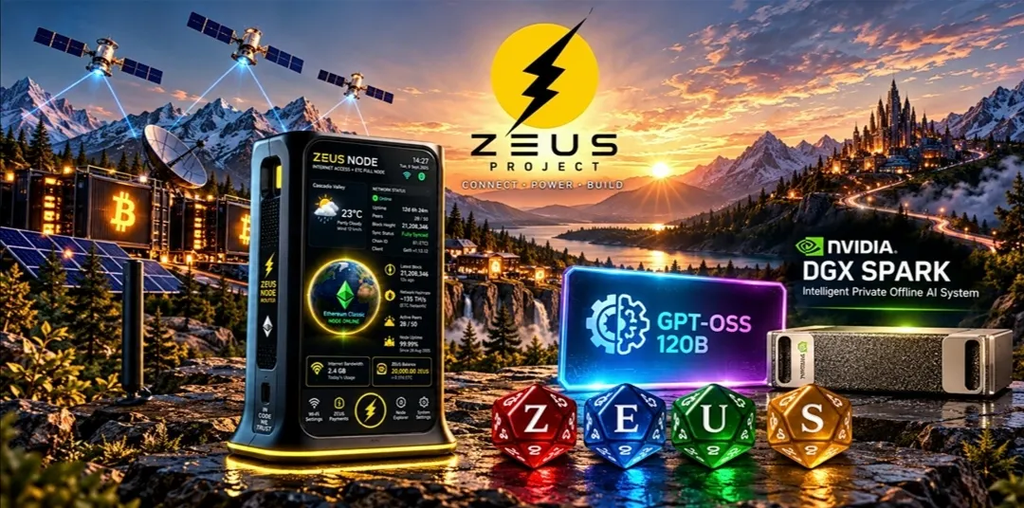
What began in September 2022 as a relatively simple blockchain experiment has evolved into a much broader engineering initiative spanning decentralized applications, Bitcoin infrastructure, sovereign communications, digital art, blockchain gaming, physical node infrastructure and private artificial intelligence.
The technology has expanded considerably.
The philosophy has remained remarkably consistent:
Build technology that people can understand, operate and ultimately control themselves.
That principle now connects nearly everything being developed under the Zeus Project.
From ZEUS Coin and Ethereum Classic applications to Bitcoin commerce, physical infrastructure and locally deployable AI, the project explores what becomes possible when individuals gain greater ownership over the technology beneath their digital lives.
From ZEUS Coin to the ZEUS Ecosystem
ZEUS operates on the Ethereum Classic network — a Proof-of-Work blockchain with an EVM-compatible smart-contract environment.
ZEUS Contract Address:0x66e97838A985cf070B9F955c4025f1C7825de44F
Ethereum Classic provides an interesting environment for experimentation because applications can combine programmable smart contracts with a Proof-of-Work blockchain.
The original ZEUS Project vision focused heavily on Bitcoin nodes, the Lightning Network and an ERC-20 utility token deployed on Ethereum Classic.
A lot has happened since then.
What began as an exploration of Bitcoin and Ethereum Classic infrastructure has gradually developed into a broader engineering project involving decentralized applications, encrypted communication, Bitcoin commerce, digital collectibles, blockchain gaming, physical infrastructure and open-source artificial intelligence.
Rather than treating ZEUS purely as a digital asset, the project’s development direction has increasingly focused on creating practical utility around the token.
That distinction matters.
A blockchain ecosystem becomes far more interesting when tokens interact with real software and infrastructure — sending messages, accessing encryption services, claiming rewards, participating in games or interacting with decentralized applications.
Several applications are now being developed around this idea.
1. ZEUS Mail — Blockchain-Native Communication
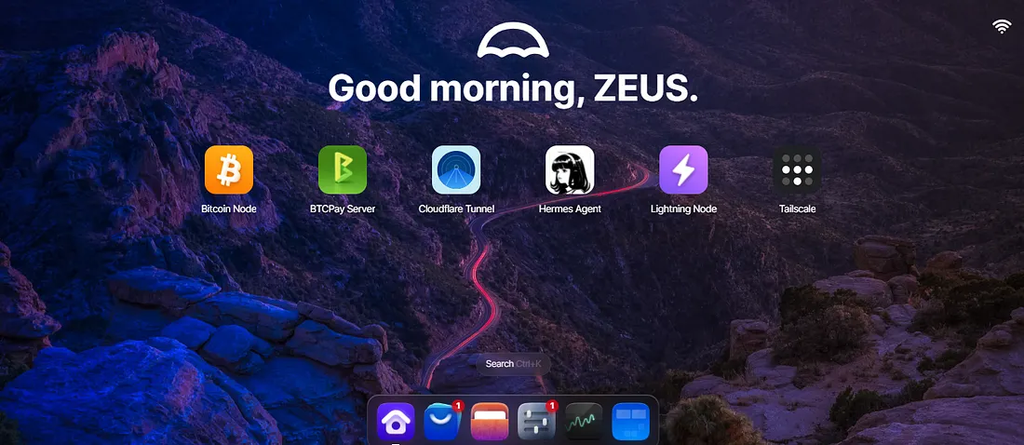
One of the most important developments in the project is ZEUS Mail.
ZEUS Mail explores a fundamentally different model of electronic communication.
Traditional email depends on centralized providers, user accounts, databases and server infrastructure.
ZEUS Mail explores an alternative architecture in which users connect an Ethereum Classic-compatible wallet and communicate through the application using their wallet identity.
Messages are protected using client-side AES-256-GCM encryption, while Ethereum Classic smart-contract infrastructure provides the underlying blockchain communication layer.
Sending a message consumes ZEUS, creating direct utility for the token inside an actual application.
The interface is intentionally familiar, with features including:
- Inbox
- Sent
- Bookmarks
- Archive
- Trash
- Encrypted messaging
- Wallet integration
- IPFS attachments
But beneath that familiar interface sits a very different architecture.
ZEUS Mail is therefore more than another messaging application.
It is an experiment in what communication software could look like when cryptographic identity, encryption and decentralized infrastructure converge.
Longer term, ZEUS Mail could also become an educational communication layer connecting users across the wider Zeus ecosystem.
2. ZEUS Encryption — Encryption as a Blockchain Utility
ZEUS Encryption extends the same philosophy into secure information storage.
The application allows users to encrypt information before interacting with the Ethereum Classic smart-contract backend.
The architectural principle is straightforward:
Encryption happens on the user’s side.
Sensitive plaintext does not need to be handed to a centralized service for processing.
Instead, the project explores how client-side cryptography can work alongside blockchain infrastructure.
ZEUS is used to access the application’s encryption and storage functionality, creating another practical utility layer within the ecosystem.
ZEUS Mail and ZEUS Encryption together demonstrate an important direction for the project:
Blockchain applications do not have to revolve exclusively around trading.
They can also become tools for communication, security, identity and information sovereignty.
3. ZEUS Faucet — Giving People Somewhere to Start
Blockchain education becomes considerably easier when people can actually experiment.
That is the purpose of the ZEUS Faucet.
Users can connect an Ethereum Classic-compatible wallet and claim ZEUS subject to the application’s claim controls and cooldown period.
The faucet provides developers, students and curious users with an accessible entry point into the ecosystem.
Instead of requiring someone to purchase a token before they can begin experimenting, the faucet creates a simple educational pathway:
Connect → Claim → Experiment → Learn → Build
Once ZEUS has been claimed, users can explore applications such as ZEUS Mail and ZEUS Encryption.
The faucet may be a relatively small part of the overall ecosystem, but its purpose is important:
Lower the barrier to experimentation.
4. Celestial Arts — Where Bitcoin Meets Physical Art
One of the most visually distinctive branches of the Zeus Project is Celestial Arts.
Readers of the original version of this article may remember early references to the Celestial Eggs of Olympus.
Those ideas have since evolved into a much more substantial collectible art project.
Celestial Arts consists of limited-edition physical artwork organized into individually catalogued series, including:
- Aurora
- Majestic Heights
- Verdant
- Stellar
- Ancient
- Summit
- Twilight
- Aerial
- Enchanted
- Luminescence
- Reflection
Rather than forcing every part of the project onto a smart contract simply because blockchain technology is available, Celestial Arts is being designed around Bitcoin-native commerce.
The store infrastructure is being developed around a self-hosted BTCPay Server and Bitcoin node environment, allowing Bitcoin payments without depending entirely on conventional payment processors.
This creates an important distinction.
The artwork may be what the collector sees.
Behind it sits an opportunity to demonstrate what sovereign Bitcoin commerce can look like.
Celestial Arts is therefore not simply an art project.
It is also an experiment combining:
Physical Art + Bitcoin + Self-Hosted Infrastructure + Sovereign Commerce
5. The Genesis Heist — Storytelling on Ethereum Classic
Not everything we build needs to look like infrastructure.
Sometimes the best way to introduce technology is through a story.
The Genesis Heist is a Web3 comic project built around an ERC-721 smart contract deployed on Ethereum Classic.
The story follows Lila Voss, Jaxon Reed, Maya Chen and Tariq Hassan through the fictional Cascadia Valley universe.
The project combines illustrated storytelling with blockchain ownership and a browser-based comic reader.
But The Genesis Heist serves another purpose as well.
It demonstrates how Ethereum Classic smart contracts can support applications far beyond conventional financial transactions.
Communication, encryption, collectibles, art, storytelling and games can all share the same underlying programmable blockchain infrastructure.
The Genesis Heist therefore becomes both a creative project and a technical experiment.
6. ZEUS Asteroid Blaster — Turning Blockchain Education Into a Game
The ZEUS ecosystem is also moving into gaming.
ZEUS Asteroid Blaster is being designed as a browser-based space combat game combining modern web graphics with Ethereum Classic reward infrastructure.
Players will pilot spacecraft through increasingly difficult environments while fighting asteroid fields and increasingly powerful enemies.
But the long-term vision goes considerably further than a simple arcade game.
Future encounters are planned around powerful characters inspired by Greek mythology. Players will face boss battles involving hostile planetary environments, asteroids and other celestial objects before reaching protected worlds.
Victory can unlock ZEUS rewards and new parts of the game universe.
The objective is to make blockchain interaction something users experience through gameplay rather than something they must first understand through technical documentation.
The game is planned around technologies including:
- Three.js
- Blender
- React
- Ethereum Classic smart contracts
Server-side systems will also play an important role in protecting reward mechanics against abuse.
The goal is simple:
Make blockchain technology something people can learn by using it.
7. ZEUS Node — Infrastructure You Can Physically Own
Software applications ultimately depend upon infrastructure.
That brings us to one of the most important future stages of the Zeus Project:
ZEUS Node.
The concept is to develop a dedicated physical node and networking appliance capable of providing sovereign access to blockchain infrastructure while also functioning as a communications device.
Instead of depending indefinitely on somebody else’s public RPC endpoint, applications could communicate with infrastructure operated directly by the developer, organization or community.
For the Ethereum Classic side of the Zeus Project, this is particularly significant.
ZEUS Mail, ZEUS Encryption, the Faucet, games and future applications all ultimately need reliable access to blockchain data.
Running dedicated ETC node infrastructure provides greater control over that connection.
The broader ZEUS Node concept also explores networking technologies such as satellite connectivity and resilient communications.
The result is envisioned as something between:
a blockchain gateway, a networking appliance and an educational platform.
This brings the project remarkably close to ideas described in the earliest versions of the ZEUS vision.
The difference is that there are now applications waiting for that infrastructure.
Recent project discussions similarly describe the ZEUS Node as an eventual ETC full-node and networking appliance, with development following the launch of the current application layer.
8. The Zeus Bitcoin Node Farm Project
ZEUS Node represents the individual infrastructure unit.
The longer-term vision scales that principle considerably further.
The Zeus Bitcoin Node Farm Project
Imagine resilient clusters of Bitcoin infrastructure powered increasingly by renewable energy and connected through multiple communications technologies.
Solar generation.
Bitcoin full nodes.
Lightning infrastructure.
Satellite communications.
High-speed networking.
Self-hosted payment infrastructure.
Secure hardware.
Local computing.
And eventually private AI systems helping engineers monitor and maintain the environment.
The purpose is not simply to create another conventional data center.
It is to investigate how energy, communications, Bitcoin infrastructure and computing can be brought together into increasingly self-sufficient technology installations.
At smaller scale, these concepts can be explored by individuals, developers and universities.
At larger scale, they could potentially become distributed infrastructure installations.
The long-term objective is to explore how decentralized computing, energy and communications can work together as one resilient infrastructure layer.
The Other Revolution: Sovereign Artificial Intelligence
Something else has changed dramatically since the original ZEUS article was published.
Artificial intelligence has advanced at extraordinary speed.
For the Zeus Project, this has created another area of research that fits naturally alongside Bitcoin and decentralized infrastructure:
Open-source AI that people can download, archive, study and run themselves.
We have been building a multi-terabyte offline AI model vault containing open-source models and the runtimes required to experiment with them locally.
The purpose is educational.
Instead of understanding AI exclusively as an internet service accessed through somebody else’s server, engineers should also understand what happens when a model is stored on their own hardware and inference happens locally.
That means learning about: From a blockchain token experiment to an expanding ecosystem of decentralized applications, Bitcoin infrastructure, sovereign communications, digital art, gaming and private artificial intelligence.
In September 2022, ZEUS began with a relatively simple idea:
Could we use Proof-of-Work blockchain technology to encourage people to learn, build and operate decentralized infrastructure?
The original ZEUS Project vision centred heavily on Bitcoin nodes, the Lightning Network and an ERC-20 utility token deployed on the Ethereum Classic blockchain.
A lot has happened since then.
What began as an exploration of Bitcoin and Ethereum Classic infrastructure has gradually developed into a much broader engineering project spanning decentralized applications, encrypted communication, Bitcoin commerce, digital collectibles, blockchain gaming, physical node infrastructure and open-source artificial intelligence.
The underlying philosophy, however, has remained remarkably consistent:
Build technology that people can run, understand and ultimately control themselves.
That principle now connects nearly everything being developed under Zeus Project.
From ZEUS Coin to the ZEUS Ecosystem
ZEUS operates on the Ethereum Classic network — a Proof-of-Work blockchain with an EVM-compatible smart-contract environment.
ZEUS Contract Address: 0x66e97838A985cf070B9F955c4025f1C7825de44F
Ethereum Classic gives us an interesting engineering environment because applications can combine programmable smart contracts with a Proof-of-Work blockchain.
Rather than treating ZEUS purely as a speculative digital asset, our development direction has increasingly focused on giving the token utility inside applications.
That distinction matters.
A blockchain ecosystem becomes far more interesting when tokens are being used to interact with software: sending messages, accessing encryption services, claiming rewards or participating in games.
Several applications are now being built around this idea.

1. ZEUS Mail — Blockchain-Native Communication
One of the most important developments in the project has been ZEUS Mail.
ZEUS Mail explores a very different model of electronic communication.
Traditional email depends upon centralized mail providers, accounts, servers and databases. ZEUS Mail instead uses an Ethereum Classic smart contract as part of its messaging infrastructure.
Users connect their blockchain wallet and communicate through the application using their wallet identity.
Messages are protected using client-side AES-256-GCM encryption, while the underlying smart-contract system provides the blockchain communication layer.
Sending a message consumes ZEUS, creating direct utility for the token inside an actual application.
The interface is deliberately familiar, with features including:
Inbox — Sent — Bookmarks — Archive — Trash — encrypted messaging — wallet integration — IPFS attachments.
But beneath that familiar interface sits a radically different architecture.
ZEUS Mail is therefore more than another messaging application.
It is an experiment in what communication software might look like when cryptographic identity, encryption and decentralized infrastructure converge.
Longer term, we also see ZEUS Mail becoming an educational communication layer connecting users across the wider Zeus ecosystem.

2. ZEUS Encryption — Encryption as a Blockchain Utility
ZEUS Encryption extends the same philosophy into secure information storage.
The application allows users to encrypt information before interacting with the Ethereum Classic smart-contract backend.
The important architectural principle is simple:
Encryption happens on the user’s side.
Sensitive plaintext does not need to be handed to a centralized service for processing.
ZEUS is used to access the application’s encryption and storage functionality, providing another practical utility layer within the ecosystem.
ZEUS Mail and ZEUS Encryption together demonstrate an important direction for the project:
Blockchain applications do not have to revolve exclusively around trading. They can be tools for communication, security, identity and information sovereignty.

3. ZEUS Faucet — Giving People Somewhere to Start
Blockchain education becomes considerably easier when people can actually experiment.
That is the purpose of the ZEUS Faucet.
Users connect an Ethereum Classic-compatible wallet and can claim ZEUS subject to the application’s claim controls and cooldown period.
The faucet gives developers, students and curious users an entry point into the ecosystem without requiring their first interaction to be purchasing a token.
Once ZEUS has been claimed, it can be used to explore applications such as ZEUS Mail and ZEUS Encryption.
This creates a simple educational pathway:
Connect → Claim → Experiment → Learn → Build.
The faucet therefore plays a small but important role in the wider project.

4. Celestial Arts — Where Bitcoin Meets Physical Art
One of the most visually distinctive branches of Zeus Project is Celestial Arts.
Readers of the original version of this article may remember early references to the Celestial Eggs of Olympus.
Those concepts have since evolved into a much more substantial collectible art project.
Celestial Arts consists of limited-edition physical artwork organised into individually catalogued series, including Aurora, Majestic Heights, Verdant, Stellar, Ancient, Summit, Twilight, Aerial, Enchanted, Luminescence and Reflection.
Instead of forcing everything onto a smart contract simply because blockchain technology is available, Celestial Arts is being designed around Bitcoin-native commerce.
Our store infrastructure is being developed around a self-hosted BTCPay Server and Bitcoin node environment, allowing Bitcoin payments without depending entirely upon conventional payment processors.

This is an important distinction.
The artwork may be what the collector sees.
Behind it sits an opportunity to demonstrate what sovereign Bitcoin commerce actually looks like.

5. The Genesis Heist — Storytelling on Ethereum Classic
Not everything we build needs to look like infrastructure.
Sometimes the best way to introduce technology is through a story.
The Genesis Heist is a Web3 comic project built around an ERC-721 smart contract deployed on Ethereum Classic.
The story follows Lila Voss, Jaxon Reed, Maya Chen and Tariq Hassan through the fictional Cascadia Valley universe.
The project combines illustrated storytelling with blockchain ownership and a browser-based comic reader.
The Genesis Heist serves another purpose as well: demonstrating how Ethereum Classic smart contracts can support applications far beyond financial transactions.
Communication, encryption, collectibles, art, storytelling and games can all share the same underlying programmable blockchain infrastructure.

6. ZEUS Asteroid Blaster — Turning Blockchain Education Into a Game
The next major application takes the ecosystem into gaming.
ZEUS Asteroid Blaster is being designed as a browser-based space combat game combining modern web graphics with Ethereum Classic reward infrastructure.
Players will pilot spacecraft through increasingly difficult environments while fighting asteroid fields and powerful enemies.
But we want the project to become considerably more ambitious than a simple arcade game.
Future encounters are planned around powerful characters inspired by Greek mythology. Players will face boss battles involving hostile planetary environments, asteroids and other celestial objects before reaching protected worlds.
Victory can unlock ZEUS rewards and new parts of the game’s universe.
The objective is to make blockchain interaction something users experience through gameplay rather than something they must first understand through technical documentation.
The game is planned around technologies including Three.js, Blender, React and Ethereum Classic smart contracts, with server-side systems protecting reward mechanics against abuse.

7. ZEUS Node — Infrastructure You Can Physically Own
Software applications ultimately depend upon infrastructure.
That brings us to one of the most important future stages of Zeus Project:
ZEUS Node.
The concept is to develop a dedicated physical node and networking appliance capable of providing sovereign access to blockchain infrastructure while also functioning as a communications device.
Rather than depending indefinitely on somebody else’s public RPC endpoint, applications can communicate with infrastructure operated by the developer, organisation or community itself.
For the Ethereum Classic side of Zeus Project, this is particularly significant.
ZEUS Mail, ZEUS Encryption, the Faucet, games and future applications ultimately need reliable access to blockchain data.
Running dedicated ETC node infrastructure gives us greater control over that connection.
The broader ZEUS Node concept also explores networking technologies such as satellite connectivity and resilient communications — turning the node into part blockchain gateway, part networking appliance and part educational platform.
This brings the project remarkably close to the ideas described in the first version of this article years ago.
Except now there are applications waiting for that infrastructure.

8. The Zeus Bitcoin Node Farm Project
ZEUS Node represents the individual infrastructure unit.
The longer-term vision scales that principle considerably further.
The Zeus Bitcoin Node Farm Project
Imagine resilient clusters of Bitcoin infrastructure powered increasingly by renewable energy and connected through multiple communications technologies.
Solar generation.
Bitcoin full nodes.
Lightning infrastructure.
Satellite communications.
High-speed networking.
Self-hosted payment infrastructure.
Secure hardware.
Local computing.
And eventually private AI systems helping engineers monitor and maintain the environment.
The purpose is not simply to create another data centre.
It is to investigate how energy, communications, Bitcoin infrastructure and computing can be brought together into increasingly self-sufficient technology installations.
Get ZeusProject’s stories in your inbox
Join Medium for free to get updates from this writer.Subscribe
Remember me for faster sign in
At smaller scale, these concepts can be explored by individuals and universities.
At larger scale, they could become distributed infrastructure installations.

The Other Revolution: Sovereign Artificial Intelligence
Something else has changed dramatically since the original ZEUS article was published.
Artificial intelligence has advanced at extraordinary speed.
For Zeus Project, this has created another area of research that fits naturally alongside Bitcoin and decentralized infrastructure:
open-source AI that people can download, archive, study and run themselves.
We have been building a multi-terabyte offline AI model vault containing open-source models and the runtimes required to experiment with them locally.
The purpose is educational.
Instead of understanding AI exclusively as an internet service accessed through somebody else’s server, engineers should also understand what happens when the model is sitting on their own storage, running on their own hardware.
That means learning about:
model weights,
quantisation,
GGUF,
local inference,
Python environments,
llama.cpp,
GPU and CPU requirements,
model storage,
multimodal systems,
AI agents,
and the enormous computing infrastructure behind modern artificial intelligence.
This work has already produced a detailed Zeus Project guide:
Building Your Own Open-Source AI LLMs Locally

Why Bitcoin, Ethereum Classic and Open-Source AI Belong in the Same Conversation
At first glance these technologies may appear unrelated.
Bitcoin is money and settlement infrastructure.
Ethereum Classic provides programmable Proof-of-Work smart contracts.
Open-source AI provides locally deployable machine intelligence.
Networking technologies connect machines.
Renewable energy keeps those machines operating.
Encryption protects their information.
But zoom out far enough and a common theme appears:
technological sovereignty.
A Bitcoin full node allows you to independently verify the Bitcoin blockchain.
An Ethereum Classic node allows applications to communicate directly with the ETC network.
Self-hosted BTCPay Server infrastructure allows a merchant to accept Bitcoin without outsourcing the entire payment stack.
Client-side encryption reduces dependence on trusted intermediaries.
A locally stored open-source language model allows intelligence to operate without every interaction being sent to a remote AI provider.
These technologies solve different problems.
But they teach the same lesson:
Understanding infrastructure matters.
Education Is Part of the Infrastructure
ZEUS Project is therefore becoming as much an engineering education project as an application ecosystem.
We want people to understand what happens underneath the interfaces they use every day.
What actually happens when you run a Bitcoin node?
What does an RPC endpoint do?
How does a smart contract execute?
How does AES encryption protect a message?
How does BTCPay Server process a Bitcoin invoice?
How does a browser communicate with Ethereum Classic?
What does a 100-billion-parameter AI model actually look like when downloaded onto a physical drive?
How much hardware does it require?
What happens when that model is quantised?
How could renewable energy, satellite communications, blockchain nodes and private AI eventually operate together?
These are questions worth exploring.
And the best way to learn them is often simply to build something.
One Ecosystem, Many Experiments
The different Zeus Project applications may appear very different on the surface.
ZEUS Mail explores decentralized encrypted communication.
ZEUS Encryption explores client-side cryptography and blockchain storage.
ZEUS Faucet provides an accessible entry point into the ecosystem.
Celestial Arts connects physical collectible art with sovereign Bitcoin commerce.
The Genesis Heist explores storytelling and digital ownership on Ethereum Classic.
ZEUS Asteroid Blaster brings blockchain rewards into interactive gaming.
ZEUS Node takes the project into physical blockchain and communications infrastructure.
The Zeus Bitcoin Node Farm Project expands that thinking toward renewable, distributed Bitcoin infrastructure.
And our Open-Source AI programme teaches engineers how to build and preserve increasingly capable private AI systems.
They are different experiments.
But they are all pieces of the same question:
What can we build when individuals once again own more of the infrastructure beneath their digital lives?
The Road Ahead
The original version of this article was written when many of these projects were still ideas.
Today we have smart contracts, working applications, infrastructure, physical hardware, artwork, AI models and increasingly ambitious engineering plans.
There is still a considerable amount to build.
That is precisely what makes the journey interesting.
The next stage of Zeus Project will focus on completing and launching the existing application ecosystem before moving deeper into ZEUS Node, blockchain gaming and larger-scale Bitcoin infrastructure development.
Beyond that lies the longer-term challenge:
bringing together renewable energy, Bitcoin nodes, Ethereum Classic infrastructure, resilient networking, self-hosted services and increasingly capable private artificial intelligence.
We don’t know exactly where every experiment will lead.
But we know what we want people to do with the work:
Learn from it.
Build on it.
Run your own infrastructure.
Teach somebody else how it works.
Because decentralization is ultimately not created by a logo, a token or a protocol.
It happens when more people possess the knowledge and tools required to operate the infrastructure themselves.

Continue Exploring Zeus Project
Open-Source AI
[GUIDE — Building Your Own Open-Source AI LLMs Locally]
ZEUS Mail
[Application— ZEUS Mail Blockchain eMail Program]
ZEUS Encryption
[Application— ZEUS Encryption Blockchain Program]
ZEUS Faucet
[Application- ZEUS Faucet Application]
Bitcoin Celestial Arts
[Application— Bitcoin Celestial Arts Store]
The Genesis Heist Web3 Comic
[Application— The Genesis Heist Comic]
ZEUS Asteroid Blaster
[Application— In development launching soon]
ZEUS Node
[Node Device— ZEUS Node Hardware in Prototype Development]
Bitcoin Node Farm
[Project— Development in Planning]
ZEUS Token
Ethereum Classic ERC-20 Smart Contract Address: 0x66e97838A985cf070B9F955c4025f1C7825de44F

Zeus Project develops decentralized applications, Bitcoin and Ethereum Classic infrastructure, open-source AI education and experimental technologies designed to help engineers understand, build and operate increasingly sovereign digital systems.
Build. Learn. Verify. Own your infrastructure.
🌐 Follow the project for updates on Twitter/X @ZeusPayETC
- Model weights
- Quantization
- GGUF
- Local inference
- Python environments
- llama.cpp
- GPU and CPU requirements
- Model storage
- Multimodal systems
- AI agents
- Local AI infrastructure
This work has already produced a detailed Zeus Project guide:
[GUIDE — Building Your Own Open-Source AI LLMs Locally]
The broader message is simple:
Sovereign AI begins with understanding how AI works underneath the interface.
The project’s published AI material similarly emphasizes understanding models, formats, runtimes and local hardware rather than treating AI purely as a remote service.
Why Bitcoin, Ethereum Classic and Open-Source AI Belong in the Same Conversation
At first glance, these technologies may appear unrelated.
Bitcoin is monetary and settlement infrastructure.
Ethereum Classic provides programmable Proof-of-Work smart contracts.
Open-source AI provides locally deployable machine intelligence.
Networking technologies connect machines.
Renewable energy keeps those machines operating.
Encryption protects their information.
But zoom out far enough and a common theme appears:
Technological sovereignty.
A Bitcoin full node allows you to independently verify the Bitcoin blockchain.
An Ethereum Classic node allows applications to communicate directly with the ETC network.
Self-hosted BTCPay Server infrastructure allows a merchant to accept Bitcoin without outsourcing the entire payment stack.
Client-side encryption reduces dependence on trusted intermediaries.
A locally stored open-source language model allows intelligence to operate without every interaction being sent to a remote AI provider.
These technologies solve different problems.
But they teach the same lesson:
Understanding infrastructure matters.
Education Is Part of the Infrastructure
ZEUS Project is therefore becoming as much an engineering education project as an application ecosystem.
We want people to understand what happens underneath the interfaces they use every day.
What actually happens when you run a Bitcoin node?
What does an RPC endpoint do?
How does a smart contract execute?
How does AES encryption protect a message?
How does BTCPay Server process a Bitcoin invoice?
How does a browser communicate with Ethereum Classic?
What does a massive AI model actually look like when downloaded onto a physical drive?
How much hardware does it require?
What happens when that model is quantized?
How could renewable energy, satellite communications, blockchain nodes and private AI eventually operate together?
These are questions worth exploring.
And the best way to learn them is often simply to build something.
One Ecosystem, Many Experiments
From a blockchain token experiment to an expanding ecosystem of decentralized applications, Bitcoin infrastructure, sovereign communications, digital art, gaming and private artificial intelligence.
In September 2022, ZEUS began with a relatively simple idea:
Could we use Proof-of-Work blockchain technology to encourage people to learn, build and operate decentralized infrastructure?
The original ZEUS Project vision centred heavily on Bitcoin nodes, the Lightning Network and an ERC-20 utility token deployed on the Ethereum Classic blockchain.
A lot has happened since then.
What began as an exploration of Bitcoin and Ethereum Classic infrastructure has gradually developed into a much broader engineering project spanning decentralized applications, encrypted communication, Bitcoin commerce, digital collectibles, blockchain gaming, physical node infrastructure and open-source artificial intelligence.
The underlying philosophy, however, has remained remarkably consistent:
Build technology that people can run, understand and ultimately control themselves.
That principle now connects nearly everything being developed under Zeus Project.
From ZEUS Coin to the ZEUS Ecosystem
ZEUS operates on the Ethereum Classic network — a Proof-of-Work blockchain with an EVM-compatible smart-contract environment.
ZEUS Contract Address: 0x66e97838A985cf070B9F955c4025f1C7825de44F
Ethereum Classic gives us an interesting engineering environment because applications can combine programmable smart contracts with a Proof-of-Work blockchain.
Rather than treating ZEUS purely as a speculative digital asset, our development direction has increasingly focused on giving the token utility inside applications.
That distinction matters.
A blockchain ecosystem becomes far more interesting when tokens are being used to interact with software: sending messages, accessing encryption services, claiming rewards or participating in games.
Several applications are now being built around this idea.
1. ZEUS Mail — Blockchain-Native Communication
One of the most important developments in the project has been ZEUS Mail.
ZEUS Mail explores a very different model of electronic communication.
Traditional email depends upon centralized mail providers, accounts, servers and databases. ZEUS Mail instead uses an Ethereum Classic smart contract as part of its messaging infrastructure.
Users connect their blockchain wallet and communicate through the application using their wallet identity.
Messages are protected using client-side AES-256-GCM encryption, while the underlying smart-contract system provides the blockchain communication layer.
Sending a message consumes ZEUS, creating direct utility for the token inside an actual application.
The interface is deliberately familiar, with features including:
Inbox — Sent — Bookmarks — Archive — Trash — encrypted messaging — wallet integration — IPFS attachments.
But beneath that familiar interface sits a radically different architecture.
ZEUS Mail is therefore more than another messaging application.
It is an experiment in what communication software might look like when cryptographic identity, encryption and decentralized infrastructure converge.
Longer term, we also see ZEUS Mail becoming an educational communication layer connecting users across the wider Zeus ecosystem.
2. ZEUS Encryption — Encryption as a Blockchain Utility
ZEUS Encryption extends the same philosophy into secure information storage.
The application allows users to encrypt information before interacting with the Ethereum Classic smart-contract backend.
The important architectural principle is simple:
Encryption happens on the user’s side.
Sensitive plaintext does not need to be handed to a centralized service for processing.
ZEUS is used to access the application’s encryption and storage functionality, providing another practical utility layer within the ecosystem.
ZEUS Mail and ZEUS Encryption together demonstrate an important direction for the project:
Blockchain applications do not have to revolve exclusively around trading. They can be tools for communication, security, identity and information sovereignty.
3. ZEUS Faucet — Giving People Somewhere to Start
Blockchain education becomes considerably easier when people can actually experiment.
That is the purpose of the ZEUS Faucet.
Users connect an Ethereum Classic-compatible wallet and can claim ZEUS subject to the application’s claim controls and cooldown period.
The faucet gives developers, students and curious users an entry point into the ecosystem without requiring their first interaction to be purchasing a token.
Once ZEUS has been claimed, it can be used to explore applications such as ZEUS Mail and ZEUS Encryption.
This creates a simple educational pathway:
Connect → Claim → Experiment → Learn → Build.
The faucet therefore plays a small but important role in the wider project.
4. Celestial Arts — Where Bitcoin Meets Physical Art
One of the most visually distinctive branches of Zeus Project is Celestial Arts.
Readers of the original version of this article may remember early references to the Celestial Eggs of Olympus.
Those concepts have since evolved into a much more substantial collectible art project.
Celestial Arts consists of limited-edition physical artwork organised into individually catalogued series, including Aurora, Majestic Heights, Verdant, Stellar, Ancient, Summit, Twilight, Aerial, Enchanted, Luminescence and Reflection.
Instead of forcing everything onto a smart contract simply because blockchain technology is available, Celestial Arts is being designed around Bitcoin-native commerce.
Our store infrastructure is being developed around a self-hosted BTCPay Server and Bitcoin node environment, allowing Bitcoin payments without depending entirely upon conventional payment processors.
This is an important distinction.
The artwork may be what the collector sees.
Behind it sits an opportunity to demonstrate what sovereign Bitcoin commerce actually looks like.
5. The Genesis Heist — Storytelling on Ethereum Classic
Not everything we build needs to look like infrastructure.
Sometimes the best way to introduce technology is through a story.
The Genesis Heist is a Web3 comic project built around an ERC-721 smart contract deployed on Ethereum Classic.
The story follows Lila Voss, Jaxon Reed, Maya Chen and Tariq Hassan through the fictional Cascadia Valley universe.
The project combines illustrated storytelling with blockchain ownership and a browser-based comic reader.
The Genesis Heist serves another purpose as well: demonstrating how Ethereum Classic smart contracts can support applications far beyond financial transactions.
Communication, encryption, collectibles, art, storytelling and games can all share the same underlying programmable blockchain infrastructure.
6. ZEUS Asteroid Blaster — Turning Blockchain Education Into a Game
The next major application takes the ecosystem into gaming.
ZEUS Asteroid Blaster is being designed as a browser-based space combat game combining modern web graphics with Ethereum Classic reward infrastructure.
Players will pilot spacecraft through increasingly difficult environments while fighting asteroid fields and powerful enemies.
But we want the project to become considerably more ambitious than a simple arcade game.
Future encounters are planned around powerful characters inspired by Greek mythology. Players will face boss battles involving hostile planetary environments, asteroids and other celestial objects before reaching protected worlds.
Victory can unlock ZEUS rewards and new parts of the game’s universe.
The objective is to make blockchain interaction something users experience through gameplay rather than something they must first understand through technical documentation.
The game is planned around technologies including Three.js, Blender, React and Ethereum Classic smart contracts, with server-side systems protecting reward mechanics against abuse.
7. ZEUS Node — Infrastructure You Can Physically Own
Software applications ultimately depend upon infrastructure.
That brings us to one of the most important future stages of Zeus Project:
ZEUS Node.
The concept is to develop a dedicated physical node and networking appliance capable of providing sovereign access to blockchain infrastructure while also functioning as a communications device.
Rather than depending indefinitely on somebody else’s public RPC endpoint, applications can communicate with infrastructure operated by the developer, organisation or community itself.
For the Ethereum Classic side of Zeus Project, this is particularly significant.
ZEUS Mail, ZEUS Encryption, the Faucet, games and future applications ultimately need reliable access to blockchain data.
Running dedicated ETC node infrastructure gives us greater control over that connection.
The broader ZEUS Node concept also explores networking technologies such as satellite connectivity and resilient communications — turning the node into part blockchain gateway, part networking appliance and part educational platform.
This brings the project remarkably close to the ideas described in the first version of this article years ago.
Except now there are applications waiting for that infrastructure.
8. The Zeus Bitcoin Node Farm Project
ZEUS Node represents the individual infrastructure unit.
The longer-term vision scales that principle considerably further.
The Zeus Bitcoin Node Farm Project
Imagine resilient clusters of Bitcoin infrastructure powered increasingly by renewable energy and connected through multiple communications technologies.
Solar generation.
Bitcoin full nodes.
Lightning infrastructure.
Satellite communications.
High-speed networking.
Self-hosted payment infrastructure.
Secure hardware.
Local computing.
And eventually private AI systems helping engineers monitor and maintain the environment.
The purpose is not simply to create another data centre.
It is to investigate how energy, communications, Bitcoin infrastructure and computing can be brought together into increasingly self-sufficient technology installations.
Get ZeusProject’s stories in your inbox
Join Medium for free to get updates from this writer.Subscribe
Remember me for faster sign in
At smaller scale, these concepts can be explored by individuals and universities.
At larger scale, they could become distributed infrastructure installations.
The Other Revolution: Sovereign Artificial Intelligence
Something else has changed dramatically since the original ZEUS article was published.
Artificial intelligence has advanced at extraordinary speed.
For Zeus Project, this has created another area of research that fits naturally alongside Bitcoin and decentralized infrastructure:
open-source AI that people can download, archive, study and run themselves.
We have been building a multi-terabyte offline AI model vault containing open-source models and the runtimes required to experiment with them locally.
The purpose is educational.
Instead of understanding AI exclusively as an internet service accessed through somebody else’s server, engineers should also understand what happens when the model is sitting on their own storage, running on their own hardware.
That means learning about:
model weights,
quantisation,
GGUF,
local inference,
Python environments,
llama.cpp,
GPU and CPU requirements,
model storage,
multimodal systems,
AI agents,
and the enormous computing infrastructure behind modern artificial intelligence.
This work has already produced a detailed Zeus Project guide:
Building Your Own Open-Source AI LLMs Locally
Why Bitcoin, Ethereum Classic and Open-Source AI Belong in the Same Conversation
At first glance these technologies may appear unrelated.
Bitcoin is money and settlement infrastructure.
Ethereum Classic provides programmable Proof-of-Work smart contracts.
Open-source AI provides locally deployable machine intelligence.
Networking technologies connect machines.
Renewable energy keeps those machines operating.
Encryption protects their information.
But zoom out far enough and a common theme appears:
technological sovereignty.
A Bitcoin full node allows you to independently verify the Bitcoin blockchain.
An Ethereum Classic node allows applications to communicate directly with the ETC network.
Self-hosted BTCPay Server infrastructure allows a merchant to accept Bitcoin without outsourcing the entire payment stack.
Client-side encryption reduces dependence on trusted intermediaries.
A locally stored open-source language model allows intelligence to operate without every interaction being sent to a remote AI provider.
These technologies solve different problems.
But they teach the same lesson:
Understanding infrastructure matters.
Education Is Part of the Infrastructure
ZEUS Project is therefore becoming as much an engineering education project as an application ecosystem.
We want people to understand what happens underneath the interfaces they use every day.
What actually happens when you run a Bitcoin node?
What does an RPC endpoint do?
How does a smart contract execute?
How does AES encryption protect a message?
How does BTCPay Server process a Bitcoin invoice?
How does a browser communicate with Ethereum Classic?
What does a 100-billion-parameter AI model actually look like when downloaded onto a physical drive?
How much hardware does it require?
What happens when that model is quantised?
How could renewable energy, satellite communications, blockchain nodes and private AI eventually operate together?
These are questions worth exploring.
And the best way to learn them is often simply to build something.
One Ecosystem, Many Experiments
The different Zeus Project applications may appear very different on the surface.
ZEUS Mail explores decentralized encrypted communication.
ZEUS Encryption explores client-side cryptography and blockchain storage.
ZEUS Faucet provides an accessible entry point into the ecosystem.
Celestial Arts connects physical collectible art with sovereign Bitcoin commerce.
The Genesis Heist explores storytelling and digital ownership on Ethereum Classic.
ZEUS Asteroid Blaster brings blockchain rewards into interactive gaming.
ZEUS Node takes the project into physical blockchain and communications infrastructure.
The Zeus Bitcoin Node Farm Project expands that thinking toward renewable, distributed Bitcoin infrastructure.
And our Open-Source AI programme teaches engineers how to build and preserve increasingly capable private AI systems.
They are different experiments.
But they are all pieces of the same question:
What can we build when individuals once again own more of the infrastructure beneath their digital lives?
The Road Ahead
The original version of this article was written when many of these projects were still ideas.
Today we have smart contracts, working applications, infrastructure, physical hardware, artwork, AI models and increasingly ambitious engineering plans.
There is still a considerable amount to build.
That is precisely what makes the journey interesting.
The next stage of Zeus Project will focus on completing and launching the existing application ecosystem before moving deeper into ZEUS Node, blockchain gaming and larger-scale Bitcoin infrastructure development.
Beyond that lies the longer-term challenge:
bringing together renewable energy, Bitcoin nodes, Ethereum Classic infrastructure, resilient networking, self-hosted services and increasingly capable private artificial intelligence.
We don’t know exactly where every experiment will lead.
But we know what we want people to do with the work:
Learn from it.
Build on it.
Run your own infrastructure.
Teach somebody else how it works.
Because decentralization is ultimately not created by a logo, a token or a protocol.
It happens when more people possess the knowledge and tools required to operate the infrastructure themselves.
Continue Exploring Zeus Project
Open-Source AI
[GUIDE — Building Your Own Open-Source AI LLMs Locally]
ZEUS Mail
[Application— ZEUS Mail Blockchain eMail Program]
ZEUS Encryption
[Application— ZEUS Encryption Blockchain Program]
ZEUS Faucet
[Application- ZEUS Faucet Application]
Bitcoin Celestial Arts
[Application— Bitcoin Celestial Arts Store]
The Genesis Heist Web3 Comic
[Application— The Genesis Heist Comic]
ZEUS Asteroid Blaster
[Application— In development launching soon]
ZEUS Node
[Node Device— ZEUS Node Hardware in Prototype Development]
Bitcoin Node Farm
[Project— Development in Planning]
ZEUS Token
Ethereum Classic ERC-20 Smart Contract Address: 0x66e97838A985cf070B9F955c4025f1C7825de44F
Zeus Project develops decentralized applications, Bitcoin and Ethereum Classic infrastructure, open-source AI education and experimental technologies designed to help engineers understand, build and operate increasingly sovereign digital systems.
Build. Learn. Verify. Own your infrastructure.
🌐 Follow the project for updates on Twitter/X @ZeusPayETC
The different Zeus Project applications may appear very different on the surface.
ZEUS Mail explores decentralized encrypted communication.
ZEUS Encryption explores client-side cryptography and blockchain-based information storage.
ZEUS Faucet provides an accessible entry point into the ecosystem.
Celestial Arts connects physical collectible art with sovereign Bitcoin commerce.
The Genesis Heist explores storytelling and digital ownership on Ethereum Classic.
ZEUS Asteroid Blaster brings blockchain rewards into interactive gaming.
ZEUS Node takes the project into physical blockchain and communications infrastructure.
The Zeus Bitcoin Node Farm Project expands that thinking toward renewable, distributed Bitcoin infrastructure.
And the Open-Source AI program teaches engineers how to build, preserve and operate increasingly capable private AI systems.
They are different experiments.
But they are all pieces of the same question:
What can we build when individuals once again own more of the infrastructure beneath their digital lives?
The Road Ahead
The original version of this article was written when many of these projects were still ideas.
Today, the ecosystem includes smart contracts, working applications, infrastructure experiments, physical hardware development, artwork, AI models and increasingly ambitious engineering plans.
There is still a considerable amount to build.
That is precisely what makes the journey interesting.
The next stage of Zeus Project will focus on completing and launching the existing application ecosystem before moving deeper into ZEUS Node, blockchain gaming and larger-scale Bitcoin infrastructure development.
Beyond that lies the longer-term challenge:
Bringing together renewable energy, Bitcoin nodes, Ethereum Classic infrastructure, resilient networking, self-hosted services and increasingly capable private artificial intelligence.
We do not know exactly where every experiment will lead.
But we know what we want people to do with the work:
Learn from it.
Build on it.
Run your own infrastructure.
Teach somebody else how it works.
Because decentralization is ultimately not created by a logo, a token or a protocol.
It happens when more people possess the knowledge and tools required to operate the infrastructure themselves.
Continue Exploring Zeus Project
From a blockchain token experiment to an expanding ecosystem of decentralized applications, Bitcoin infrastructure, sovereign communications, digital art, gaming and private artificial intelligence.
In September 2022, ZEUS began with a relatively simple idea:
Could we use Proof-of-Work blockchain technology to encourage people to learn, build and operate decentralized infrastructure?
The original ZEUS Project vision centred heavily on Bitcoin nodes, the Lightning Network and an ERC-20 utility token deployed on the Ethereum Classic blockchain.
A lot has happened since then.
What began as an exploration of Bitcoin and Ethereum Classic infrastructure has gradually developed into a much broader engineering project spanning decentralized applications, encrypted communication, Bitcoin commerce, digital collectibles, blockchain gaming, physical node infrastructure and open-source artificial intelligence.
The underlying philosophy, however, has remained remarkably consistent:
Build technology that people can run, understand and ultimately control themselves.
That principle now connects nearly everything being developed under Zeus Project.
From ZEUS Coin to the ZEUS Ecosystem
ZEUS operates on the Ethereum Classic network — a Proof-of-Work blockchain with an EVM-compatible smart-contract environment.
ZEUS Contract Address: 0x66e97838A985cf070B9F955c4025f1C7825de44F
Ethereum Classic gives us an interesting engineering environment because applications can combine programmable smart contracts with a Proof-of-Work blockchain.
Rather than treating ZEUS purely as a speculative digital asset, our development direction has increasingly focused on giving the token utility inside applications.
That distinction matters.
A blockchain ecosystem becomes far more interesting when tokens are being used to interact with software: sending messages, accessing encryption services, claiming rewards or participating in games.
Several applications are now being built around this idea.
1. ZEUS Mail — Blockchain-Native Communication
One of the most important developments in the project has been ZEUS Mail.
ZEUS Mail explores a very different model of electronic communication.
Traditional email depends upon centralized mail providers, accounts, servers and databases. ZEUS Mail instead uses an Ethereum Classic smart contract as part of its messaging infrastructure.
Users connect their blockchain wallet and communicate through the application using their wallet identity.
Messages are protected using client-side AES-256-GCM encryption, while the underlying smart-contract system provides the blockchain communication layer.
Sending a message consumes ZEUS, creating direct utility for the token inside an actual application.
The interface is deliberately familiar, with features including:
Inbox — Sent — Bookmarks — Archive — Trash — encrypted messaging — wallet integration — IPFS attachments.
But beneath that familiar interface sits a radically different architecture.
ZEUS Mail is therefore more than another messaging application.
It is an experiment in what communication software might look like when cryptographic identity, encryption and decentralized infrastructure converge.
Longer term, we also see ZEUS Mail becoming an educational communication layer connecting users across the wider Zeus ecosystem.
2. ZEUS Encryption — Encryption as a Blockchain Utility
ZEUS Encryption extends the same philosophy into secure information storage.
The application allows users to encrypt information before interacting with the Ethereum Classic smart-contract backend.
The important architectural principle is simple:
Encryption happens on the user’s side.
Sensitive plaintext does not need to be handed to a centralized service for processing.
ZEUS is used to access the application’s encryption and storage functionality, providing another practical utility layer within the ecosystem.
ZEUS Mail and ZEUS Encryption together demonstrate an important direction for the project:
Blockchain applications do not have to revolve exclusively around trading. They can be tools for communication, security, identity and information sovereignty.
3. ZEUS Faucet — Giving People Somewhere to Start
Blockchain education becomes considerably easier when people can actually experiment.
That is the purpose of the ZEUS Faucet.
Users connect an Ethereum Classic-compatible wallet and can claim ZEUS subject to the application’s claim controls and cooldown period.
The faucet gives developers, students and curious users an entry point into the ecosystem without requiring their first interaction to be purchasing a token.
Once ZEUS has been claimed, it can be used to explore applications such as ZEUS Mail and ZEUS Encryption.
This creates a simple educational pathway:
Connect → Claim → Experiment → Learn → Build.
The faucet therefore plays a small but important role in the wider project.
4. Celestial Arts — Where Bitcoin Meets Physical Art
One of the most visually distinctive branches of Zeus Project is Celestial Arts.
Readers of the original version of this article may remember early references to the Celestial Eggs of Olympus.
Those concepts have since evolved into a much more substantial collectible art project.
Celestial Arts consists of limited-edition physical artwork organised into individually catalogued series, including Aurora, Majestic Heights, Verdant, Stellar, Ancient, Summit, Twilight, Aerial, Enchanted, Luminescence and Reflection.
Instead of forcing everything onto a smart contract simply because blockchain technology is available, Celestial Arts is being designed around Bitcoin-native commerce.
Our store infrastructure is being developed around a self-hosted BTCPay Server and Bitcoin node environment, allowing Bitcoin payments without depending entirely upon conventional payment processors.
This is an important distinction.
The artwork may be what the collector sees.
Behind it sits an opportunity to demonstrate what sovereign Bitcoin commerce actually looks like.
5. The Genesis Heist — Storytelling on Ethereum Classic
Not everything we build needs to look like infrastructure.
Sometimes the best way to introduce technology is through a story.
The Genesis Heist is a Web3 comic project built around an ERC-721 smart contract deployed on Ethereum Classic.
The story follows Lila Voss, Jaxon Reed, Maya Chen and Tariq Hassan through the fictional Cascadia Valley universe.
The project combines illustrated storytelling with blockchain ownership and a browser-based comic reader.
The Genesis Heist serves another purpose as well: demonstrating how Ethereum Classic smart contracts can support applications far beyond financial transactions.
Communication, encryption, collectibles, art, storytelling and games can all share the same underlying programmable blockchain infrastructure.
6. ZEUS Asteroid Blaster — Turning Blockchain Education Into a Game
The next major application takes the ecosystem into gaming.
ZEUS Asteroid Blaster is being designed as a browser-based space combat game combining modern web graphics with Ethereum Classic reward infrastructure.
Players will pilot spacecraft through increasingly difficult environments while fighting asteroid fields and powerful enemies.
But we want the project to become considerably more ambitious than a simple arcade game.
Future encounters are planned around powerful characters inspired by Greek mythology. Players will face boss battles involving hostile planetary environments, asteroids and other celestial objects before reaching protected worlds.
Victory can unlock ZEUS rewards and new parts of the game’s universe.
The objective is to make blockchain interaction something users experience through gameplay rather than something they must first understand through technical documentation.
The game is planned around technologies including Three.js, Blender, React and Ethereum Classic smart contracts, with server-side systems protecting reward mechanics against abuse.
7. ZEUS Node — Infrastructure You Can Physically Own
Software applications ultimately depend upon infrastructure.
That brings us to one of the most important future stages of Zeus Project:
ZEUS Node.
The concept is to develop a dedicated physical node and networking appliance capable of providing sovereign access to blockchain infrastructure while also functioning as a communications device.
Rather than depending indefinitely on somebody else’s public RPC endpoint, applications can communicate with infrastructure operated by the developer, organisation or community itself.
For the Ethereum Classic side of Zeus Project, this is particularly significant.
ZEUS Mail, ZEUS Encryption, the Faucet, games and future applications ultimately need reliable access to blockchain data.
Running dedicated ETC node infrastructure gives us greater control over that connection.
The broader ZEUS Node concept also explores networking technologies such as satellite connectivity and resilient communications — turning the node into part blockchain gateway, part networking appliance and part educational platform.
This brings the project remarkably close to the ideas described in the first version of this article years ago.
Except now there are applications waiting for that infrastructure.
8. The Zeus Bitcoin Node Farm Project
ZEUS Node represents the individual infrastructure unit.
The longer-term vision scales that principle considerably further.
The Zeus Bitcoin Node Farm Project
Imagine resilient clusters of Bitcoin infrastructure powered increasingly by renewable energy and connected through multiple communications technologies.
Solar generation.
Bitcoin full nodes.
Lightning infrastructure.
Satellite communications.
High-speed networking.
Self-hosted payment infrastructure.
Secure hardware.
Local computing.
And eventually private AI systems helping engineers monitor and maintain the environment.
The purpose is not simply to create another data centre.
It is to investigate how energy, communications, Bitcoin infrastructure and computing can be brought together into increasingly self-sufficient technology installations.
Get ZeusProject’s stories in your inbox
Join Medium for free to get updates from this writer.Subscribe
Remember me for faster sign in
At smaller scale, these concepts can be explored by individuals and universities.
At larger scale, they could become distributed infrastructure installations.
The Other Revolution: Sovereign Artificial Intelligence
Something else has changed dramatically since the original ZEUS article was published.
Artificial intelligence has advanced at extraordinary speed.
For Zeus Project, this has created another area of research that fits naturally alongside Bitcoin and decentralized infrastructure:
open-source AI that people can download, archive, study and run themselves.
We have been building a multi-terabyte offline AI model vault containing open-source models and the runtimes required to experiment with them locally.
The purpose is educational.
Instead of understanding AI exclusively as an internet service accessed through somebody else’s server, engineers should also understand what happens when the model is sitting on their own storage, running on their own hardware.
That means learning about:
model weights,
quantisation,
GGUF,
local inference,
Python environments,
llama.cpp,
GPU and CPU requirements,
model storage,
multimodal systems,
AI agents,
and the enormous computing infrastructure behind modern artificial intelligence.
This work has already produced a detailed Zeus Project guide:
Building Your Own Open-Source AI LLMs Locally
Why Bitcoin, Ethereum Classic and Open-Source AI Belong in the Same Conversation
At first glance these technologies may appear unrelated.
Bitcoin is money and settlement infrastructure.
Ethereum Classic provides programmable Proof-of-Work smart contracts.
Open-source AI provides locally deployable machine intelligence.
Networking technologies connect machines.
Renewable energy keeps those machines operating.
Encryption protects their information.
But zoom out far enough and a common theme appears:
technological sovereignty.
A Bitcoin full node allows you to independently verify the Bitcoin blockchain.
An Ethereum Classic node allows applications to communicate directly with the ETC network.
Self-hosted BTCPay Server infrastructure allows a merchant to accept Bitcoin without outsourcing the entire payment stack.
Client-side encryption reduces dependence on trusted intermediaries.
A locally stored open-source language model allows intelligence to operate without every interaction being sent to a remote AI provider.
These technologies solve different problems.
But they teach the same lesson:
Understanding infrastructure matters.
Education Is Part of the Infrastructure
ZEUS Project is therefore becoming as much an engineering education project as an application ecosystem.
We want people to understand what happens underneath the interfaces they use every day.
What actually happens when you run a Bitcoin node?
What does an RPC endpoint do?
How does a smart contract execute?
How does AES encryption protect a message?
How does BTCPay Server process a Bitcoin invoice?
How does a browser communicate with Ethereum Classic?
What does a 100-billion-parameter AI model actually look like when downloaded onto a physical drive?
How much hardware does it require?
What happens when that model is quantised?
How could renewable energy, satellite communications, blockchain nodes and private AI eventually operate together?
These are questions worth exploring.
And the best way to learn them is often simply to build something.
One Ecosystem, Many Experiments
The different Zeus Project applications may appear very different on the surface.
ZEUS Mail explores decentralized encrypted communication.
ZEUS Encryption explores client-side cryptography and blockchain storage.
ZEUS Faucet provides an accessible entry point into the ecosystem.
Celestial Arts connects physical collectible art with sovereign Bitcoin commerce.
The Genesis Heist explores storytelling and digital ownership on Ethereum Classic.
ZEUS Asteroid Blaster brings blockchain rewards into interactive gaming.
ZEUS Node takes the project into physical blockchain and communications infrastructure.
The Zeus Bitcoin Node Farm Project expands that thinking toward renewable, distributed Bitcoin infrastructure.
And our Open-Source AI programme teaches engineers how to build and preserve increasingly capable private AI systems.
They are different experiments.
But they are all pieces of the same question:
What can we build when individuals once again own more of the infrastructure beneath their digital lives?
The Road Ahead
The original version of this article was written when many of these projects were still ideas.
Today we have smart contracts, working applications, infrastructure, physical hardware, artwork, AI models and increasingly ambitious engineering plans.
There is still a considerable amount to build.
That is precisely what makes the journey interesting.
The next stage of Zeus Project will focus on completing and launching the existing application ecosystem before moving deeper into ZEUS Node, blockchain gaming and larger-scale Bitcoin infrastructure development.
Beyond that lies the longer-term challenge:
bringing together renewable energy, Bitcoin nodes, Ethereum Classic infrastructure, resilient networking, self-hosted services and increasingly capable private artificial intelligence.
We don’t know exactly where every experiment will lead.
But we know what we want people to do with the work:
Learn from it.
Build on it.
Run your own infrastructure.
Teach somebody else how it works.
Because decentralization is ultimately not created by a logo, a token or a protocol.
It happens when more people possess the knowledge and tools required to operate the infrastructure themselves.
Continue Exploring Zeus Project
Open-Source AI
[GUIDE — Building Your Own Open-Source AI LLMs Locally]
ZEUS Mail
[Application— ZEUS Mail Blockchain eMail Program]
ZEUS Encryption
[Application— ZEUS Encryption Blockchain Program]
ZEUS Faucet
[Application- ZEUS Faucet Application]
Bitcoin Celestial Arts
[Application— Bitcoin Celestial Arts Store]
The Genesis Heist Web3 Comic
[Application— The Genesis Heist Comic]
ZEUS Asteroid Blaster
[Application— In development launching soon]
ZEUS Node
[Node Device— ZEUS Node Hardware in Prototype Development]
Bitcoin Node Farm
[Project— Development in Planning]
ZEUS Token
Ethereum Classic ERC-20 Smart Contract Address: 0x66e97838A985cf070B9F955c4025f1C7825de44F
Zeus Project develops decentralized applications, Bitcoin and Ethereum Classic infrastructure, open-source AI education and experimental technologies designed to help engineers understand, build and operate increasingly sovereign digital systems.
Build. Learn. Verify. Own your infrastructure.
🌐 Follow the project for updates on Twitter/X @ZeusPayETC
Open-Source AI
[GUIDE — Building Your Own Open-Source AI LLMs Locally]
ZEUS Mail
[Application — ZEUS Mail Blockchain eMail Program]
ZEUS Encryption
[Application — ZEUS Encryption Blockchain Program]
ZEUS Faucet
[Application — ZEUS Faucet Application]
Bitcoin Celestial Arts
[Application — Bitcoin Celestial Arts Store]
The Genesis Heist Web3 Comic
[Application — The Genesis Heist Comic]
ZEUS Asteroid Blaster
[Application — In development launching soon]
ZEUS Node
[Node Device — ZEUS Node Hardware in Prototype Development]
Bitcoin Node Farm
[Project — Development in Planning]
ZEUS Token
Network: Ethereum Classic
Token Standard: ERC-20
Smart Contract Address:0x66e97838A985cf070B9F955c4025f1C7825de44F
The contract address is consistent with the earlier ZEUS Project publication.
Step-by-Step Guide: Configuring ZEUS Wallet on MetaMask & Trezor Security Hardware
[Step-by-step Guide Configuring ZEUS Wallet on MetaMask & Trezor Security Hardware]
This guide is intended to help users understand how ZEUS can be accessed and managed through Ethereum Classic-compatible wallet infrastructure and security hardware.
As always, users should independently verify network details, smart-contract addresses and transaction information before interacting with digital assets.
Build. Learn. Verify. Own.
The Zeus Project is ultimately not about a single token, application or blockchain.
It is about exploring a different relationship with technology.
A relationship in which users can understand the systems they depend on.
Developers can operate their own infrastructure.
Communities can experiment with decentralized networks.
Businesses can explore sovereign payment systems.
Engineers can run open-source AI locally.
And individuals can learn what exists beneath the polished interfaces of modern digital life.
Decentralization is not created by a logo.
It is not created by a token.
And it is not created simply by deploying a smart contract.
Decentralization becomes meaningful when more people have the knowledge, software, hardware and infrastructure required to operate systems for themselves.
From a blockchain token experiment to an expanding ecosystem of decentralized applications, Bitcoin infrastructure, sovereign communications, digital art, gaming and private artificial intelligence.
In September 2022, ZEUS began with a relatively simple idea:
Could we use Proof-of-Work blockchain technology to encourage people to learn, build and operate decentralized infrastructure?
The original ZEUS Project vision centred heavily on Bitcoin nodes, the Lightning Network and an ERC-20 utility token deployed on the Ethereum Classic blockchain.
A lot has happened since then.
What began as an exploration of Bitcoin and Ethereum Classic infrastructure has gradually developed into a much broader engineering project spanning decentralized applications, encrypted communication, Bitcoin commerce, digital collectibles, blockchain gaming, physical node infrastructure and open-source artificial intelligence.
The underlying philosophy, however, has remained remarkably consistent:
Build technology that people can run, understand and ultimately control themselves.
That principle now connects nearly everything being developed under Zeus Project.
From ZEUS Coin to the ZEUS Ecosystem
ZEUS operates on the Ethereum Classic network — a Proof-of-Work blockchain with an EVM-compatible smart-contract environment.
ZEUS Contract Address: 0x66e97838A985cf070B9F955c4025f1C7825de44F
Ethereum Classic gives us an interesting engineering environment because applications can combine programmable smart contracts with a Proof-of-Work blockchain.
Rather than treating ZEUS purely as a speculative digital asset, our development direction has increasingly focused on giving the token utility inside applications.
That distinction matters.
A blockchain ecosystem becomes far more interesting when tokens are being used to interact with software: sending messages, accessing encryption services, claiming rewards or participating in games.
Several applications are now being built around this idea.
1. ZEUS Mail — Blockchain-Native Communication
One of the most important developments in the project has been ZEUS Mail.
ZEUS Mail explores a very different model of electronic communication.
Traditional email depends upon centralized mail providers, accounts, servers and databases. ZEUS Mail instead uses an Ethereum Classic smart contract as part of its messaging infrastructure.
Users connect their blockchain wallet and communicate through the application using their wallet identity.
Messages are protected using client-side AES-256-GCM encryption, while the underlying smart-contract system provides the blockchain communication layer.
Sending a message consumes ZEUS, creating direct utility for the token inside an actual application.
The interface is deliberately familiar, with features including:
Inbox — Sent — Bookmarks — Archive — Trash — encrypted messaging — wallet integration — IPFS attachments.
But beneath that familiar interface sits a radically different architecture.
ZEUS Mail is therefore more than another messaging application.
It is an experiment in what communication software might look like when cryptographic identity, encryption and decentralized infrastructure converge.
Longer term, we also see ZEUS Mail becoming an educational communication layer connecting users across the wider Zeus ecosystem.
2. ZEUS Encryption — Encryption as a Blockchain Utility
ZEUS Encryption extends the same philosophy into secure information storage.
The application allows users to encrypt information before interacting with the Ethereum Classic smart-contract backend.
The important architectural principle is simple:
Encryption happens on the user’s side.
Sensitive plaintext does not need to be handed to a centralized service for processing.
ZEUS is used to access the application’s encryption and storage functionality, providing another practical utility layer within the ecosystem.
ZEUS Mail and ZEUS Encryption together demonstrate an important direction for the project:
Blockchain applications do not have to revolve exclusively around trading. They can be tools for communication, security, identity and information sovereignty.
3. ZEUS Faucet — Giving People Somewhere to Start
Blockchain education becomes considerably easier when people can actually experiment.
That is the purpose of the ZEUS Faucet.
Users connect an Ethereum Classic-compatible wallet and can claim ZEUS subject to the application’s claim controls and cooldown period.
The faucet gives developers, students and curious users an entry point into the ecosystem without requiring their first interaction to be purchasing a token.
Once ZEUS has been claimed, it can be used to explore applications such as ZEUS Mail and ZEUS Encryption.
This creates a simple educational pathway:
Connect → Claim → Experiment → Learn → Build.
The faucet therefore plays a small but important role in the wider project.
4. Celestial Arts — Where Bitcoin Meets Physical Art
One of the most visually distinctive branches of Zeus Project is Celestial Arts.
Readers of the original version of this article may remember early references to the Celestial Eggs of Olympus.
Those concepts have since evolved into a much more substantial collectible art project.
Celestial Arts consists of limited-edition physical artwork organised into individually catalogued series, including Aurora, Majestic Heights, Verdant, Stellar, Ancient, Summit, Twilight, Aerial, Enchanted, Luminescence and Reflection.
Instead of forcing everything onto a smart contract simply because blockchain technology is available, Celestial Arts is being designed around Bitcoin-native commerce.
Our store infrastructure is being developed around a self-hosted BTCPay Server and Bitcoin node environment, allowing Bitcoin payments without depending entirely upon conventional payment processors.
This is an important distinction.
The artwork may be what the collector sees.
Behind it sits an opportunity to demonstrate what sovereign Bitcoin commerce actually looks like.
5. The Genesis Heist — Storytelling on Ethereum Classic
Not everything we build needs to look like infrastructure.
Sometimes the best way to introduce technology is through a story.
The Genesis Heist is a Web3 comic project built around an ERC-721 smart contract deployed on Ethereum Classic.
The story follows Lila Voss, Jaxon Reed, Maya Chen and Tariq Hassan through the fictional Cascadia Valley universe.
The project combines illustrated storytelling with blockchain ownership and a browser-based comic reader.
The Genesis Heist serves another purpose as well: demonstrating how Ethereum Classic smart contracts can support applications far beyond financial transactions.
Communication, encryption, collectibles, art, storytelling and games can all share the same underlying programmable blockchain infrastructure.
6. ZEUS Asteroid Blaster — Turning Blockchain Education Into a Game
The next major application takes the ecosystem into gaming.
ZEUS Asteroid Blaster is being designed as a browser-based space combat game combining modern web graphics with Ethereum Classic reward infrastructure.
Players will pilot spacecraft through increasingly difficult environments while fighting asteroid fields and powerful enemies.
But we want the project to become considerably more ambitious than a simple arcade game.
Future encounters are planned around powerful characters inspired by Greek mythology. Players will face boss battles involving hostile planetary environments, asteroids and other celestial objects before reaching protected worlds.
Victory can unlock ZEUS rewards and new parts of the game’s universe.
The objective is to make blockchain interaction something users experience through gameplay rather than something they must first understand through technical documentation.
The game is planned around technologies including Three.js, Blender, React and Ethereum Classic smart contracts, with server-side systems protecting reward mechanics against abuse.
7. ZEUS Node — Infrastructure You Can Physically Own
Software applications ultimately depend upon infrastructure.
That brings us to one of the most important future stages of Zeus Project:
ZEUS Node.
The concept is to develop a dedicated physical node and networking appliance capable of providing sovereign access to blockchain infrastructure while also functioning as a communications device.
Rather than depending indefinitely on somebody else’s public RPC endpoint, applications can communicate with infrastructure operated by the developer, organisation or community itself.
For the Ethereum Classic side of Zeus Project, this is particularly significant.
ZEUS Mail, ZEUS Encryption, the Faucet, games and future applications ultimately need reliable access to blockchain data.
Running dedicated ETC node infrastructure gives us greater control over that connection.
The broader ZEUS Node concept also explores networking technologies such as satellite connectivity and resilient communications — turning the node into part blockchain gateway, part networking appliance and part educational platform.
This brings the project remarkably close to the ideas described in the first version of this article years ago.
Except now there are applications waiting for that infrastructure.
8. The Zeus Bitcoin Node Farm Project
ZEUS Node represents the individual infrastructure unit.
The longer-term vision scales that principle considerably further.
The Zeus Bitcoin Node Farm Project
Imagine resilient clusters of Bitcoin infrastructure powered increasingly by renewable energy and connected through multiple communications technologies.
Solar generation.
Bitcoin full nodes.
Lightning infrastructure.
Satellite communications.
High-speed networking.
Self-hosted payment infrastructure.
Secure hardware.
Local computing.
And eventually private AI systems helping engineers monitor and maintain the environment.
The purpose is not simply to create another data centre.
It is to investigate how energy, communications, Bitcoin infrastructure and computing can be brought together into increasingly self-sufficient technology installations.
Get ZeusProject’s stories in your inbox
Join Medium for free to get updates from this writer.Subscribe
Remember me for faster sign in
At smaller scale, these concepts can be explored by individuals and universities.
At larger scale, they could become distributed infrastructure installations.
The Other Revolution: Sovereign Artificial Intelligence
Something else has changed dramatically since the original ZEUS article was published.
Artificial intelligence has advanced at extraordinary speed.
For Zeus Project, this has created another area of research that fits naturally alongside Bitcoin and decentralized infrastructure:
open-source AI that people can download, archive, study and run themselves.
We have been building a multi-terabyte offline AI model vault containing open-source models and the runtimes required to experiment with them locally.
The purpose is educational.
Instead of understanding AI exclusively as an internet service accessed through somebody else’s server, engineers should also understand what happens when the model is sitting on their own storage, running on their own hardware.
That means learning about:
model weights,
quantisation,
GGUF,
local inference,
Python environments,
llama.cpp,
GPU and CPU requirements,
model storage,
multimodal systems,
AI agents,
and the enormous computing infrastructure behind modern artificial intelligence.
This work has already produced a detailed Zeus Project guide:
Building Your Own Open-Source AI LLMs Locally
Why Bitcoin, Ethereum Classic and Open-Source AI Belong in the Same Conversation
At first glance these technologies may appear unrelated.
Bitcoin is money and settlement infrastructure.
Ethereum Classic provides programmable Proof-of-Work smart contracts.
Open-source AI provides locally deployable machine intelligence.
Networking technologies connect machines.
Renewable energy keeps those machines operating.
Encryption protects their information.
But zoom out far enough and a common theme appears:
technological sovereignty.
A Bitcoin full node allows you to independently verify the Bitcoin blockchain.
An Ethereum Classic node allows applications to communicate directly with the ETC network.
Self-hosted BTCPay Server infrastructure allows a merchant to accept Bitcoin without outsourcing the entire payment stack.
Client-side encryption reduces dependence on trusted intermediaries.
A locally stored open-source language model allows intelligence to operate without every interaction being sent to a remote AI provider.
These technologies solve different problems.
But they teach the same lesson:
Understanding infrastructure matters.
Education Is Part of the Infrastructure
ZEUS Project is therefore becoming as much an engineering education project as an application ecosystem.
We want people to understand what happens underneath the interfaces they use every day.
What actually happens when you run a Bitcoin node?
What does an RPC endpoint do?
How does a smart contract execute?
How does AES encryption protect a message?
How does BTCPay Server process a Bitcoin invoice?
How does a browser communicate with Ethereum Classic?
What does a 100-billion-parameter AI model actually look like when downloaded onto a physical drive?
How much hardware does it require?
What happens when that model is quantised?
How could renewable energy, satellite communications, blockchain nodes and private AI eventually operate together?
These are questions worth exploring.
And the best way to learn them is often simply to build something.
One Ecosystem, Many Experiments
The different Zeus Project applications may appear very different on the surface.
ZEUS Mail explores decentralized encrypted communication.
ZEUS Encryption explores client-side cryptography and blockchain storage.
ZEUS Faucet provides an accessible entry point into the ecosystem.
Celestial Arts connects physical collectible art with sovereign Bitcoin commerce.
The Genesis Heist explores storytelling and digital ownership on Ethereum Classic.
ZEUS Asteroid Blaster brings blockchain rewards into interactive gaming.
ZEUS Node takes the project into physical blockchain and communications infrastructure.
The Zeus Bitcoin Node Farm Project expands that thinking toward renewable, distributed Bitcoin infrastructure.
And our Open-Source AI programme teaches engineers how to build and preserve increasingly capable private AI systems.
They are different experiments.
But they are all pieces of the same question:
What can we build when individuals once again own more of the infrastructure beneath their digital lives?
The Road Ahead
The original version of this article was written when many of these projects were still ideas.
Today we have smart contracts, working applications, infrastructure, physical hardware, artwork, AI models and increasingly ambitious engineering plans.
There is still a considerable amount to build.
That is precisely what makes the journey interesting.
The next stage of Zeus Project will focus on completing and launching the existing application ecosystem before moving deeper into ZEUS Node, blockchain gaming and larger-scale Bitcoin infrastructure development.
Beyond that lies the longer-term challenge:
bringing together renewable energy, Bitcoin nodes, Ethereum Classic infrastructure, resilient networking, self-hosted services and increasingly capable private artificial intelligence.
We don’t know exactly where every experiment will lead.
But we know what we want people to do with the work:
Learn from it.
Build on it.
Run your own infrastructure.
Teach somebody else how it works.
Because decentralization is ultimately not created by a logo, a token or a protocol.
It happens when more people possess the knowledge and tools required to operate the infrastructure themselves.
Continue Exploring Zeus Project
Open-Source AI
[GUIDE — Building Your Own Open-Source AI LLMs Locally]
ZEUS Mail
[Application— ZEUS Mail Blockchain eMail Program]
ZEUS Encryption
[Application— ZEUS Encryption Blockchain Program]
ZEUS Faucet
[Application- ZEUS Faucet Application]
Bitcoin Celestial Arts
[Application— Bitcoin Celestial Arts Store]
The Genesis Heist Web3 Comic
[Application— The Genesis Heist Comic]
ZEUS Asteroid Blaster
[Application— In development launching soon]
ZEUS Node
[Node Device— ZEUS Node Hardware in Prototype Development]
Bitcoin Node Farm
[Project— Development in Planning]
ZEUS Token
Ethereum Classic ERC-20 Smart Contract Address: 0x66e97838A985cf070B9F955c4025f1C7825de44F
Zeus Project develops decentralized applications, Bitcoin and Ethereum Classic infrastructure, open-source AI education and experimental technologies designed to help engineers understand, build and operate increasingly sovereign digital systems.
Build. Learn. Verify. Own your infrastructure.
🌐 Follow the project for updates on Twitter/X @ZeusPayETC
That is the direction of the Zeus Project.
Build. Learn. Verify. Own your infrastructure.
🌐 Follow the project for updates on Twitter/X [@ZeusPayETC]
 tarek tarek